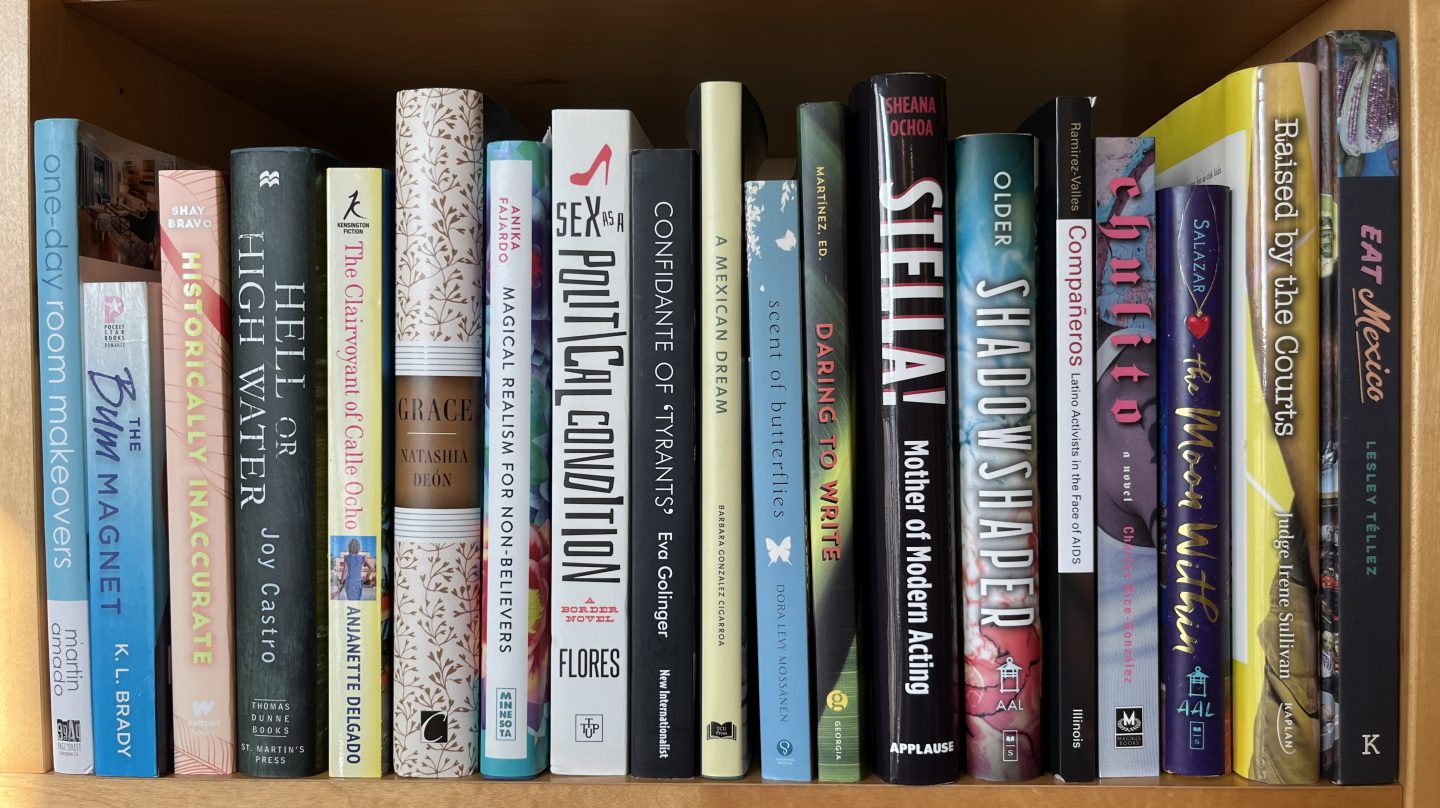

“I’ve subscribed to Latinidad since at least 2010. For years, I have secretly wished that someday I could have a book that would make your annual Latinidad List, so thank you so much for the delightful early Christmas gift! I really mean it.”— Juan Alvarado Valdivia, author of Ballad of a Slopsucker
“Thank you for forwarding all those opportunities for writers. They’re very well chosen, and I find myself forwarding many of them to people I think can take advantage of them.”—Esmeralda Santiago, author of Conquistadora
“Latinidad is really awesome. I receive a lot of these, but yours is one of the few that really seeks to give information to the writer, instead of being a brag sheet.”—Lori Perkins, literary agent
To subscribe to Latinidad, please send an e-mail with “Subscribe” in the subject line to: marcelalandres@yahoo.com.
Latinidad – Summer 2026: Emma Otheguy
Contents:
- Saludos
- Q&A: Emma Otheguy
- Resources: Jan Michalski Foundation Residency
***************************************************************
BEFORE YOU SEND IT OUT
“I found working with you to be delightful and incredibly valuable. You have keen insight and a true editorial gift and being able to combine that with an actual recipe to build a platform and work toward publication is something not a lot of other editors seem to offer. I will be eternally grateful as you have made me a better writer and knowledgeable about the business side of publishing fiction.”
—Sheila Rosart, http://www.sheilarosart.com
Ready to work with a professional editor? Visit https://marcelalandres.com.
***************************************************************
1. Saludos
My six year old daughter took one look at the cover of Cousins in the Time of Magic by Emma Otheguy and insisted I read it to her. I did, and she hung on to every word. She loves that the three main characters (like her) are Latino kids who pepper their speech with Spanish. I love learning about the role of hot air balloons in the Civil War and that a significant percentage of the Union army was foreign born or second generation.
Cousins in the Time of Magic is the first middle grade novel I read to my child—but not the last as we just devoured its sequel, Adventure in the City of Stories. Now my daughter knows about Pura Belpré, Gabriela Mistral, and Arturo Schomburg. If you don’t, let Otheguy fill in the holes left by the US education system. To learn more, read the Q&A below.
Helping Latinos get published,
Marcela Landres
marcelalandres@yahoo.com
https://marcelalandres.com
2. Q&A

Emma Otheguy is the author of several books for young readers, including the picture books A Sled for Gabo and Martina Has Too Many Tías, the bilingual picture book Martí’s Song for Freedom, and the middle grade novels Sofía Acosta Makes a Scene, Cousins in the Time of Magic, Silver Meadows Summer, and, with Adam Gidwitz, The Madre de Aguas of Cuba, part of the Unicorn Rescue Society series. Visit her at https://emmaotheguy.com/.
Q: Reading Cousins in the Time of Magic taught me more about Cinco de Mayo than I ever learned in a classroom. Thank you for writing it! Why did you chose to start the series with this particular part of history?
A: The Civil War was one of the critical turning points in our country’s history, and very few people know about how Cinco de Mayo fits into that story. By spotlighting the connections between Cinco de Mayo and the Civil War, I hoped young readers would start to understand how deeply Latin America and the United States are intertwined.
Q: Clearly your doctorate in history came in handy as you masterfully convey data in a way that feels organic to the story. How did you determine which information to keep and which to let go?
A: A lot of editing! In Cousins in the Time of Magic I focused on the historical elements that would be the most fun for children: cracking cyphers, flying in hydrogen balloons, and exploring secret tunnels. I also wanted to create scenes that would show the characters taking a stand against racism and elitism—I particularly enjoy Poly Bernatene’s illustration of Jorge, the youngest cousin, escaping from a Confederate general. Bernatene captured the righteous anger and energy I tried to write for Jorge in that scene! It was also important for me to give young readers a sense of the many diverse children who lived in the nineteenth century, which informed the characters I created for the book.
Q: Children’s books seem to work best when children are depicted as capable and adults as fallible. Case in point, the loving but perpetually distracted Tía Xía. Who, if anyone, is the inspiration for Tía Xía?
A: I have quite the cast of tías in my own family! Everything with my family seems bigger—the day-to-day drama, the volume, the dancing, the mess, and of course, the love. In my family people are perpetually on the verge of hysteria, but we sure have a good time! Tía Xía’s dogs are named for two little dogs in my family who are/were very cute but always yapping at the most inopportune times.
Through Tía Xía I also wanted to revise the stereotype of the scholar as older, male, and solemn. Intellectual, scholarly people come in all types—Tía Xía is young, chatty, and fun—which doesn’t stop her from being smart and knowledgeable about history!
Q: You are the author of a dozen books—and you have three kids! I am in awe of your time management skills. How do you carve time out of your busy life to write? Are your kids your beta readers? Has being a mom changed how you approach reading, writing, and/or publishing?
A: There has definitely been a learning curve to writing while raising young children, and I have grieved the loss of the freedom to write at any time of day or night. I try to remind myself that everyone writes around their other domestic and professional obligations—when I was in graduate school I would write my fiction in between academic assignments—although the transition to becoming a parent has felt far more significant.
I firmly believe that the best way for anyone to write is to keep coming back, and that’s what I do, after every illness, every trip, every snow day, and every day that school is inexplicably closed. “Keep coming back” is how I wrote before I had kids, and how I write now. I’ve also spent a lot of time reflecting on what pursuits are truly worthy of my time—right now, I’m not on social media, which frees up some time, but I still communicate with readers regularly through my newsletter.
But here’s the most important part of being a writer with kids, the shiniest silver lining of them all: I am reminded every day why writing children’s books matter. I see my kids delight in books and learn from them. I see how reading together makes us closer. Books are the magic that elevate our family life. Our apartment is overrun with books, and I am grateful to the author of every single one of them. Sometimes as an author myself I wonder if it was all worth it, but as a parent snuggled up with my kids and someone else’s book, I am always certain: it’s worth it.
Q: In the past you sold books at an independent bookstore and taught elementary school Spanish. How do these experiences inform your writing and/or how you promote your books?
A: I love being in schools and I’m often told after author visits that they can tell I used to be a teacher, so I suppose my teaching experience “stuck.” I also have a lot of respect for independent bookstores and am fascinated by their perspective. The editor of Cousins in the Time of Magic was once a bookseller and I think you can tell when you hold the book in your hands: there’s just a special instinct for what looks and feels just right.
Q: Who is your agent and how did you meet her?
A: Adriana Domínguez of Aevitas Creative Management, who I met (drumroll, please) at the Comadres Conference! The funny part is that Adriana doesn’t remember meeting me that first year at the conference—she must have met so many authors that day—but I learned a lot from attending that I was then able to bring to the query process, which is how I eventually signed with Adriana.
Q: You offer consultations and critiques to writers who want to learn more about the book industry and master the art of writing for kids. Has working with other writers influenced your own writing?
A: I have taught many workshops and done many one-on-one consultations and critiques: I love talking to other writers and teaching them about how the publishing industry works. Many of them have become good friends and colleagues over the years, which is always especially fun. Writers interested in one-on-one consultations can get in touch with me through my website!
Q: Other than honing their craft, what advice would you give to writers looking to land a book deal?
A: You were actually the person who once told me and a group of other writers that if we weren’t reading books, we shouldn’t expect other people to show up and buy our books when they got published. That really made an impression on me and I took it to heart! I think one of the best things you can do as an aspiring author is become a part of book culture. Get on the mailing list for your local bookstore and/or library. Attend book events and introduce yourself to people. Go to a book swap or a reading party. Join a book club. If you have kids, volunteer at the book fair or help organize an author visit. Every community is a little different, but if you are really involved in your local book culture, you’ll know exactly how to reach your readers by the time your book is published!
Q: Do you have upcoming projects that my readers should have on their radar?
A: Yes! The companion to Cousins in the Time of Magic is out this summer! Adventure in the City of Stories the cousins on a new time-travel adventure, this time to 1930s New York City, where they meet Gabriela Mistral, Pura Belpré, and Arturo Schomburg.
3. Resources
***************************************************************
JAN MICHALSKI FOUNDATION RESIDENCY
Deadline: August 31
Residencies of two weeks to three months are offered to poets, fiction writers, nonfiction writers, translators, and scholars. Beginners are accepted. Residents’ travel costs to and from their home address will be covered by the Foundation. In addition, Residents are granted a weekly allowance of CHF 400 (approximately $500); a private cabin with a kitchenette, office, and full bathroom; breakfast and lunch; and access to a research library. For more information, visit https://fondation-janmichalski.com/en/residences.
$10,000 POETRY COLLECTION PRIZE
Submission Period: September 1 – October 1
The Changes Book Prize offers $10,000, publication by Changes Press, and a launch event in New York City for a first or second collection of poems. For more information, visit https://changes.press/.
STORIES OUT OF SCHOOL FLASH FICTION CONTEST
Deadline: September 6
The Academy for Teachers offers a prize of $1000 and publication in Epiphany Magazine for a work of flash fiction in which the protagonist or narrator is a K-12 teacher. Submissions are welcome from writers who are teachers or non-teachers. For more information, visit https://www.academyforteachers.org/contests.
TUPELO PRESS SEEKS TRANSLATIONS
Tupelo Press seeks book-length works of literature in translation. They are open to submissions of both poetry and prose, as well hybrid and experimental work, and are particularly interested in works of literature being made available in English for the first time. For more information, visit https://tupelopress.org/.
MQR ONLINE
The online-only companion to the print journal Michigan Quarterly Review, MQR Online publishes book reviews, essays, arts and culture features, and author interviews. For more information, visit https://sites.lsa.umich.edu/mqr/.
*****
KNOWLEDGE IS POWER ONLY WHEN SHARED
Please forward Latinidad® widely.
***************************************************************
For more resources, follow me on:
Facebook – https://www.facebook.com/marcela.landres
Twitter – https://twitter.com/marcelalandres
Linkedin – http://www.linkedin.com/in/marcelalandres
***************************************************************
SUCCESS STORIES
Has Latinidad® been of help to you? E-mail your success stories to marcelalandres@yahoo.com.
*****
SHARE
Want to see your announcement in an upcoming issue of Latinidad®? E-mail your postings to marcelalandres@yahoo.com.
*****
REPRINTS
You are welcome to reprint part or all of this e-zine; please credit Latinidad® and include a link to https://marcelalandres.com.
*****
UNSUBSCRIBE/UPDATE E-MAIL ADDRESS
E-mail marcelalandres@yahoo.com.
***************************************************************
“I do a great deal of research. I don’t want anyone to say, ‘That could not have happened.’ It may be fiction, but it has to be true.”
—Jacquelyn Mitchard
Latinidad® © 2003 by Marcela Landres
 Marcela Landres